
Ádánd on the Kis-Koppány: Church Ruin and Historic Buildings
Accommodation in Ádánd
Ádánd on Both Sides of the Kis-Koppány
Ádánd extends on both sides of the Kis-Koppány. For visitors, this location forms the geographical setting of a place with a Romanesque church ruin, a listed church, a manor house, a castle and a geocache. The individual destinations offer different historical and practical points of interest for a stay.
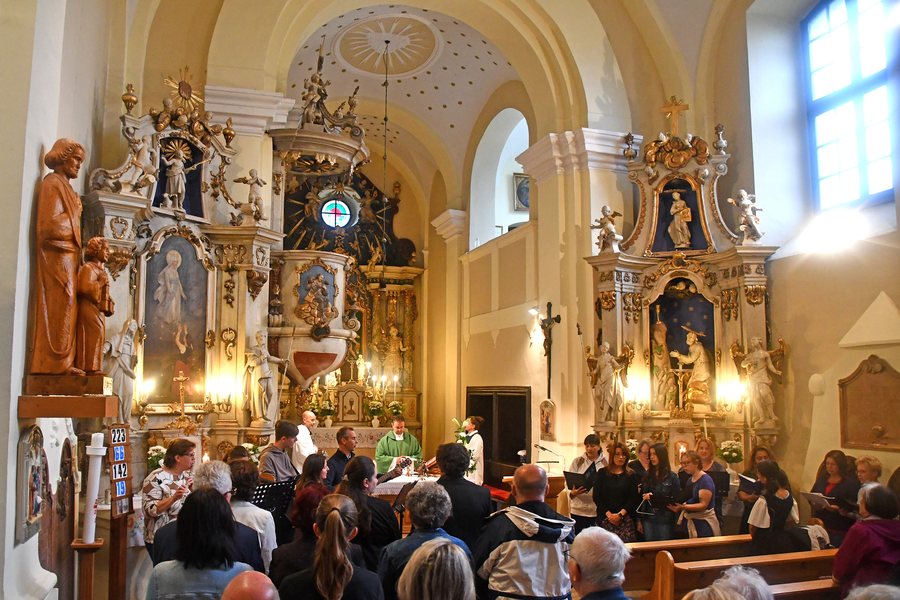 File:Ádánd, római katolikus templom (mise) 2023 02.jpg
Photo: Pasztilla aka Attila Terbócs via Wikimedia Commons, CC BY-SA 4.0
File:Ádánd, római katolikus templom (mise) 2023 02.jpg
Photo: Pasztilla aka Attila Terbócs via Wikimedia Commons, CC BY-SA 4.0
Romanesque Traces at the Hetyei templomrom
A tower 11 metres high with a square floor plan has survived from the Romanesque church building of the Hetyei templomrom. The church was probably built in the first half of the 13th century. The tower thus represents a clearly defined architectural element, while the presumed dating places the church building in the Middle Ages.
At the Hetyei templomrom, visitors can ring a handbell mounted on the wall as they wish. In addition to the surviving tower, there is therefore a specific element of the visit that can not only be viewed but also permits an action of its own. Architecture and sound provide two different ways of experiencing the site.
Sacred Buildings in Ádánd
The Roman Catholic Szentháromság Church in Ádánd is under nationwide heritage protection. In the garden of Ádánd’s Roman Catholic church stands a Classicist Immaculata statue from 1816. The church site thus combines nationwide protected status with a precisely dated individual work.
Manor House and Castle
The Tallián Manor House was built in the mid-18th century and is the oldest residential building in Ádánd. With its function as a residential building, it complements the sacred buildings with a secular historic site. For visitors interested in culture, this broadens the perspective beyond churches and religious art.
The Csapody Castle was built by Pál Csapody on the site of the former Perneszy Castle in the classicising late Baroque style (Zopfstil). Two periods are given for its construction: 1820–1827 and 1830–1859. The Csapody Castle has stood empty since 2007. The builder, the predecessor building, the style and the vacancy that has existed since 2007 are all part of Ádánd’s architectural history.
Sunday and Excursion Destination
A Catholic mass is held in Ádánd at 11 a.m. on Sundays. This specific time adds a fixed religious reference to the cultural character of the place.
The access route to the “Ádándi löszfal és versenypálya” geocache is 400 metres long from the starting point. For planning this individual destination, a clearly specified access length is therefore central. Alongside the historic buildings, the geocache provides a separate focus for an excursion.
Transport Links and Recent History
The railway connection from Siófok via Ádánd and Tab to Kaposvár connects Ádánd. Siófok is the starting point of the route, followed by Ádánd and Tab, with Kaposvár as the destination. Ádánd lies on this railway line between Siófok and Kaposvár.
After two years of preparatory, approval and construction work, the Hetyei templomrom was once again safe to visit and opened to the public from 20 November. In addition to its Romanesque architectural history, the ruin therefore also has a more recent chapter shaped by this work and the subsequent opening.
Other places connected with the same destination context: Vindornyalak, Balatonberény, Visz, Balatonszemes, Balatonfüred, Balatonfüzfö, Szentbékkálla and Balatonszabadi.

_2023_02.jpg)